
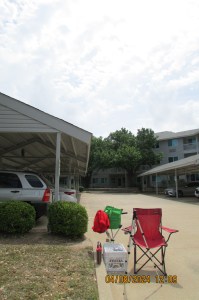
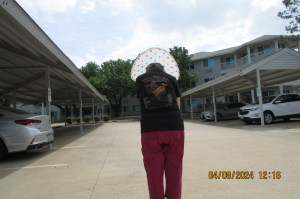
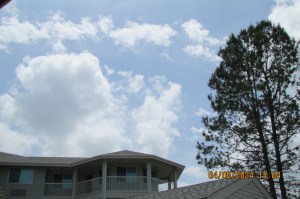
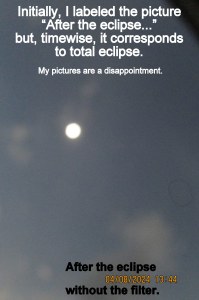
Frankly, my pictures are not very good!! Here they are, for the record, “once in a lifetime event.”

















Want to see how a solar eclipse alters colors? Wear red and green on Monday
APRIL 6, 2024, 5:01 AM ET
By Bill ChappellIf you live along the path of totality for Monday’s solar eclipse and you have any Christmas or Hanukkah gear, you might want to break it out. The celestial event will bring odd phenomena to our planet — including changes in how people see colors such as red, green and blue.
Here’s a look at some of the unusual visual effects a solar eclipse brings to humans on Earth:
Red and green colors will look strange.
That’s partly due to the change in light when the moon blocks the sun, but also the way our eyes and brain adjust to and interpret that change.As light dims, our eyes transition from photopic vision, associated with the retina’s cone cells that deliver full colors and fine detail, toward scotopic night vision that relies on rod cells to detect objects in low light. In the middle is mesopic vision, the transitional phase where both rods and cones are active.
When the light’s intensity dims in the eclipse, colors with longer wavelengths, like red, will look darker as cones become less active. But because rods are sensitive to the shorter blue-green wavelengths, those colors will have a chance to shine.
“This is pretty much a totality thing,” Erika Grundstrom, director of astronomy labs at Vanderbilt University, told NPR, with only people in the eclipse’s central path guaranteed to witness the phenomenon.
Also, she said, you shouldn’t rely on just one red or green T-shirt to trigger the effect.
“You have to have lots of people (or colorful things) around to see it,” Grundstrom said via email, adding, “the effect is the result of sudden dimness and your rods and cones trying to make sense of that dimness.”
It’s called the Purkinje effect.
The what?
The Purkinje effect, aka the Purkinje phenomenon or shift, was documented some 200 years ago by Johannes Evangelista Purkinje, a Bohemian scientist who noticed that when light passed through a prism in dimming conditions, the brightest spot moved — shifting away from red and toward blue, on the shorter end of the wavelength spectrum.The dimness should become more noticeable about 15 minutes before the eclipse reaches totality. To many people, the light takes on a metallic or silvery quality.
 Eighty-eight and counting
That’s why I don’t take pictures. Never-the-less, though the ‘once in a lifetime’ schtick is a bit oversold I am glad you had the opportunity. As I’ve related, I’ve seen two totals and now five partials and this one here in Massachusetts was quite possible the best partial I’ve seen. Amazing what you can see with a shoebox and a sewing needle 🙂
I think the pictures you took are just fine …
LikeLike